A beekeeper and maker of prayer beads reflects on what the life of a hive can teach us about attention, changing vocation, hidden acts of care and the spiritual meaning of community.
Guest post by Fiach OBroin-Molloy
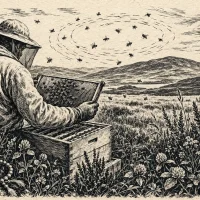
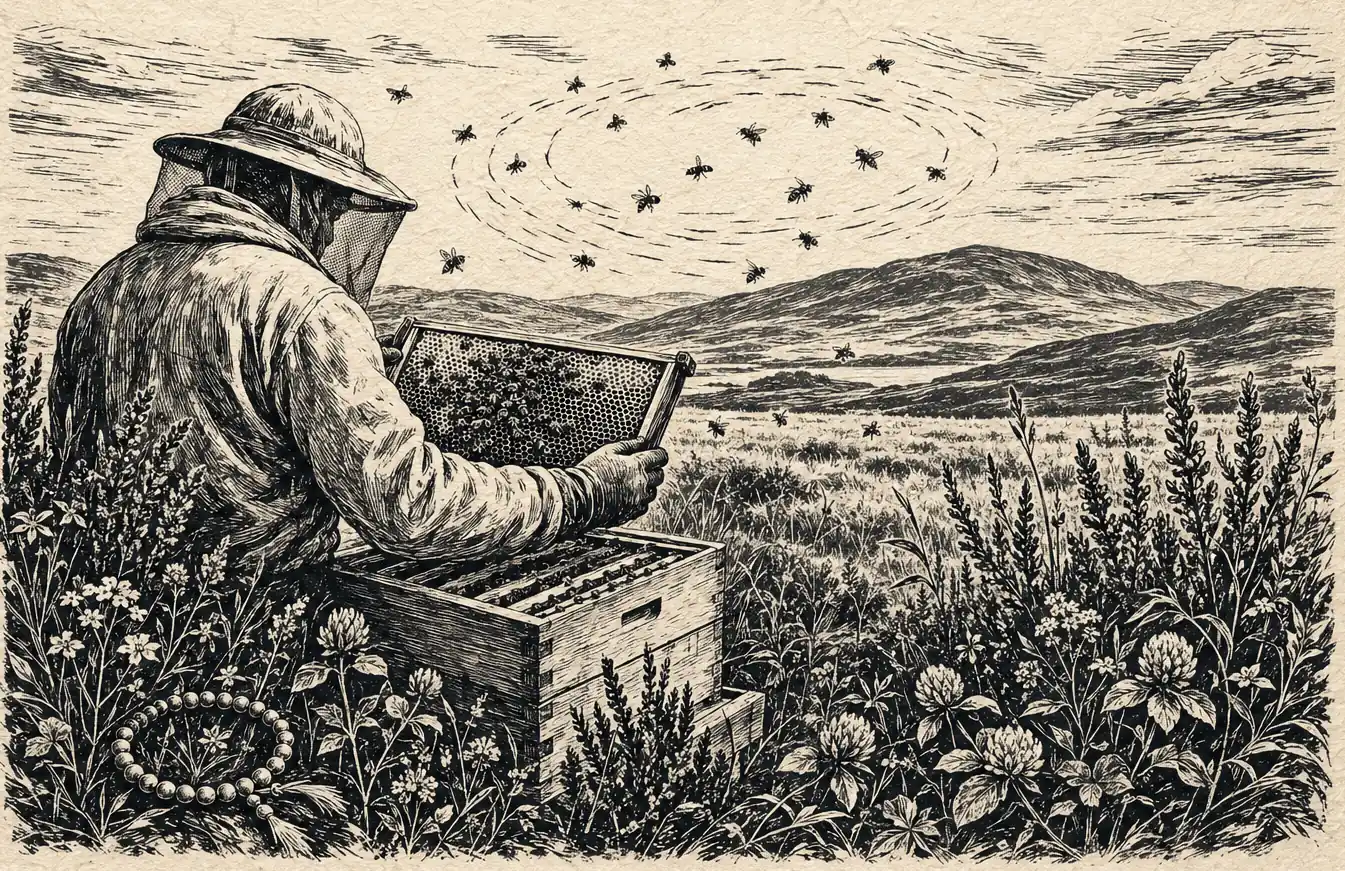
There is a moment before I open a hive when I stop.
I may have arrived carrying a list: check the queen, assess the brood, make more space, look for signs that the colony is preparing to swarm. Yet a hive cannot be entered well in a hurry. I have to notice the weather, the sound of the bees, their movement at the entrance and the general character of the day.
The work begins before I lift the roof.
It begins with attention.
That pause has come to feel like prayer.
Not because the apiary is always peaceful. It is not. Beekeeping includes stings, heavy boxes, failed queens, uncertain weather and the loss of colonies we have worked hard to protect. Nor do I believe bees are tiny saints, arranging themselves into a convenient lesson for human beings.
Still, after years of working among them, I believe the hive can help us see certain things more clearly: how purpose is discovered in relationship, how unseen work sustains a community, how repetition can gather a scattered mind and how small acts of care become larger than the person performing them.
Prayer begins with attention
Prayer is often imagined primarily as speech: praise, petition, thanksgiving or words offered into silence. It can be all of those things. But prayer may begin even earlier, with our willingness to become fully present to what is already before us.
At the hive, attention is practical. I have to look before deciding what to do. Are the bees calm or defensive? Is the colony growing strongly? Does it need more room, more food or simply to be left undisturbed?
I cannot arrive with a fixed idea and force the hive to conform to it. Care requires me to notice the reality of the colony rather than the version I expected to find.
The same may be true whenever we try to accompany another person.
To listen well is to loosen our grip on the answer we had prepared. It is to make room for someone else’s experience before attempting to interpret or repair it. Whether we call this prayer, contemplation or attentive presence, it asks us to resist rushing past what is here.
Sometimes the most spiritual thing we can do is pay attention without immediately trying to take control.
Purpose changes with the season
A worker bee does not perform one task throughout her life. Depending on her age and the needs of the colony, she may clean cells, tend developing brood, build comb, receive nectar, guard the entrance or eventually leave the hive to forage.
Her place within the community is not defined by a single permanent role.
Human beings also move through seasons of purpose. There are times for visible work and times for quiet preparation. Times to lead and times to support. Times to make something new, and times to accompany another person through illness, change or grief. Some seasons ask us to speak; others ask us to listen, recover or preserve a story that might otherwise fade.
We can become anxious when purpose changes shape. A role ends, a career alters, the people who once depended upon us no longer need us in the same way, or our own strength becomes different from what it was.
The hive offers another way of thinking about vocation. Purpose need not be one title carried unchanged for life. It can be a living response to what the present season asks of us.
A gift becomes vocation when it meets a need beyond the self.
The most important work is often hidden
The foraging bees are the easiest to notice. We see them travelling between flowers and the hive, returning with pollen or nectar. Yet much of the work that sustains the colony happens inside, beyond ordinary sight.
Brood is fed. Wax is formed. Comb is repaired. Nectar is received and transformed. Air is circulated. Temperature is regulated. Cells are cleaned and prepared for new life.
The apparent stillness of the hive conceals an extraordinary density of care.
Human communities also depend upon work that is easily overlooked: preparing a room, making a meal, remembering an anniversary, tending a grave, organising a gathering, writing a note, sitting beside someone who is frightened, or keeping the story of a beloved person alive.
This work may not produce an impressive public result. Often it is performed quietly and repeatedly, without applause. Yet communities become humane through precisely these acts.
We should not romanticise hidden labour or use the language of service to deny people rest, assistance or recognition. But we should learn to see it. Some of the work that most faithfully holds the world together will never appear on a résumé or be measured as an achievement.
It matters nevertheless.
Community is not self-erasure
The hive is sometimes presented as a simple moral illustration of self-sacrifice: every bee giving herself entirely to the whole. I am cautious about that comparison.
A beehive is not a model from which we should construct human society. Human dignity cannot be reduced to usefulness, and any community that requires people to disappear for the supposed good of the whole has misunderstood love.
The deeper lesson of the hive is not erasure, but interdependence.
No single bee contains the life of the entire colony. Yet a colony is not an abstraction floating above its individual lives. It exists through their relationships, exchanges and responses to one another.
Healthy human community also makes room for difference. It does not ask everyone to possess the same gifts or perform the same function. It recognises that wisdom, energy, creativity, practical skill, memory, hospitality and compassion may be carried by different people at different times.
Purpose is therefore not the same as being indispensable. Perhaps it is closer to being faithful to what we can offer while remaining willing to receive what others offer in return.
None of us is the whole hive.
That is not a diminishment. It is a relief.
Repetition can become prayer
My work does not end in the apiary. I also make rosaries and prayer beads by hand.
This involves its own kind of repetition: one bead, one link and one careful fastening after another. The actions are small, but they require presence. If I rush, the work suffers.
Across many spiritual traditions, prayer beads give physical rhythm to attention. The hands continue to move when the mind is tired, grieving or distracted. The next bead offers somewhere to return.
Repetition is not necessarily emptiness. When joined to attention and intention, it can become ritual.
The hive is also built through repeated actions. No single journey gathers the season’s stores. No single act of tending sustains the brood. The life of the colony emerges through innumerable contributions, most of which appear very small when viewed alone.
We often wait for the grand gesture: the moment of certainty, transformation or unmistakable calling. Yet much of spiritual life may consist of returning faithfully to the next small act.
The message answered.
The person remembered.
The meal prepared.
The prayer repeated.
The work done carefully because someone else will one day receive it.
Smallness does not prevent an action from being sacred.
The hive is not a lesson in endless productivity
Bees are frequently used as symbols of tireless work. It is easy to turn the hive into another instruction to remain busy.
But a colony lives by season, weather and limits. Bees cannot forage simply because a calendar demands it. Flowering, temperature, daylight and the condition of the colony all matter. During winter, the life of the hive gathers inward. Survival depends not upon endless outward activity, but upon conserving warmth, sharing stores and remaining close.
If the hive teaches us anything about work, it also teaches us about conditions.
We are not endlessly productive creatures, and our worth is not measured by output. There are periods when flourishing looks like expansion and others when it looks like endurance. Waiting, healing and resting are not empty spaces outside a purposeful life.
A compassionate community recognizes these seasons. It shares burdens rather than praising exhaustion. It allows a person to receive care without first proving their usefulness.
Care without control
At the end of an inspection, I return each frame, close the hive and step away.
I can provide space, food and shelter. I can respond to signs of difficulty and use the knowledge experience has given me. But I cannot command the season, guarantee the weather or control every outcome.
Beekeeping has taught me the difference between responsibility and control.
Perhaps prayer sometimes inhabits the space between them: wholehearted care without the illusion that everything finally depends upon us.
We attend to what is here. We offer the gifts we have. We accept the help of others. We do the next act of care as faithfully as we can, and then we loosen our grip upon the result.
The hive does not ask us to become bees.
It asks us to notice.
And if we notice deeply enough, perhaps we remember that none of us works, grieves, prays or flourishes alone.
About the Author
Fiach OBroin-Molloy is an Irish beekeeper and maker living in Paisley, Scotland. Through Paisley Honey, he keeps bees and designs and makes rosaries, prayer beads and devotional gifts by hand. His work explores the meeting place of faith, craft, nature, heritage and the quiet practices that help people attend, remember and pray.
Warmest wishes,
Fiach, Apiarist & Maker
Connect
Instagram: @PaisleyHoneyCo
X: @PaisleyHoneyCo:
www.paisleyhoney.com